Monday, January 26, 2026

5 different electric vehicle developments from 5 companies

1. Tesla – Growth, Challenges, and Model Evolution

Tesla remains one of the most influential EV companies globally, known for models like Model 3, Model Y, Model S, and Model X. In recent years, Tesla has been updating its core lineup with incremental improvements in range, efficiency, and software features. For instance, newer versions of the Model 3 and Model Y continue to push better real-world range figures and improved thermal management systems in the battery packs compared to earlier generations. (InsideEVs)

Despite this, Tesla faced headwinds in 2025 — including slower sales growth in some global markets and competitive pressure from Chinese and other automakers. This has prompted strategic shifts, such as refining manufacturing processes and deepening software optimization to retain market leadership. (Rest of World)

Key Development:

  • Continuous improvements in battery efficiency, vehicle range and onboard software.

  • Software updates and connectivity enhancements keep existing vehicles competitive.

  • Efforts to maintain leadership amidst intensifying global competition.


2. BYD – High-Volume Production and Charging Innovation

BYD (Build Your Dreams) is a Chinese EV giant that recently hit a major milestone by producing over 15 million electric and plug-in vehicles, a figure surpassing many traditional automakers. (Zecar)

The company is also pioneering ultra-fast charging technology with some models capable of handling up to 1,000 kW charging power, significantly reducing charging times (e.g., roughly 250 miles of range in about 5 minutes). Such advancements aim to reduce “charging anxiety” by making EV charging closer to the convenience of refuelling traditional cars. (The Verge)

Key Development:

  • Record production volume in electric and plug-in vehicles.

  • High-power charging capability targeting ultra-fast charging adoption.


3. Hyundai – Expanding EV Lineup and Architecture

South Korea’s Hyundai Motor Company is expanding its EV portfolio under the IONIQ brand. The company is preparing to launch new electric models such as the IONIQ 3, a compact EV positioned as a smaller sibling to the successful IONIQ 5. These newer models are part of Hyundai’s strategy to broaden its presence in European and global EV markets. (Electrek)

Hyundai’s EVs often use flexible platforms and advanced electrical architectures (e.g., 800-volt systems) that support faster charging and higher efficiency — features that appeal to consumers in competitive markets. (Car and Driver)

Key Development:

  • Broader EV lineup including new compact and mid-sized electric models.

  • Use of advanced electrical architecture for performance and charging.


4. Tata Motors – Local EV Growth and Feature Enhancements

Tata Motors is a leader in the Indian EV market and saw especially strong growth in 2025 with its range of electric vehicles such as the Tata Nexon EV and newer models like Harrier.ev. Its sales surge contributed to overall EV retail growth of around 77 % in India for 2025. (ETAuto.com)

One notable technological development is the Nexon EV with Level 2 Advanced Driver Assistance Systems (ADAS), offering semi-automated driving support and added comfort features — a significant step forward compared to many base EV models. (The Times of India)

Key Development:

  • Introduction of ADAS and enhanced tech in EV models.

  • Continues leadership in one of the world’s fastest-growing EV markets through feature upgrades and new launches.


5. Mahindra & Mahindra – New EV Models and Market Expansion

Mahindra & Mahindra has been actively expanding its “Born Electric” range with vehicles like the Mahindra BE 6 and XUV400 EV. The two models represent Mahindra’s push to capture significant EV market share in India, competing directly with Tata Motors and international players. (CarWale)

Mahindra’s strategy has involved offering a range of EV options designed for different needs — from smaller urban models (XUV400) to mid-sized SUVs (BE 6) — while improving battery performance and driving range to meet customer expectations. (EVINDIA)

Key Development:

  • Expanded EV lineup covering multiple vehicle segments.

  • Focus on performance and competitive pricing to grow EV adoption in India.


Summary Table of EV Developments

CompanyKey EV DevelopmentExample Models
TeslaSoftware and battery improvements; sustained global presenceTesla Model 3 / Model Y
BYDUltra-fast charging technology; record production volumesBYD Han L, Tang L
HyundaiExpanded EV lineup with new models; advanced architectureHyundai IONIQ 3 / IONIQ 5
Tata MotorsEV market leadership in India with ADAS and new modelsTata Nexon EV, Harrier.ev
Mahindra & Mahindra“Born Electric” range expansion with competitive offeringsMahindra BE 6, XUV400 EV

Conclusion

The electric vehicle industry is rapidly evolving, with each major company pushing innovation in areas such as battery performance, charging speed, driver assistance features, and diversified product portfolios. Collectively these developments are accelerating EV adoption globally while presenting exciting opportunities for technological learning and engineering advancements. (Electrek)


Recent Trends and Developments in Electric Vehicles

First, market expansion is driving scale and faster innovation. Global electric car sales surpassed 17 million in 2024, representing strong year-on-year growth and making EVs a significant portion of new vehicle sales. Forecasts for 2025 indicate EVs will account for roughly one in four cars sold in many markets, which increases demand for power systems, control electronics and charging networks. This accelerating adoption creates both opportunities and engineering constraints: higher volumes demand lower-cost powertrains and standardised charging solutions, while grid impacts require advanced energy-management strategies. (IEA)

Battery technology remains the central engineering frontier. Research and industry activity in 2024–2025 focused on higher energy density, faster charging and improved safety. Solid-state batteries are emerging as a promising advance because they replace liquid electrolytes with solid ones, reducing the risk of thermal runaway and enabling higher energy densities. At the same time, alternatives such as sodium-ion chemistries and improvements in cell manufacturing aim to lower cost and reduce reliance on constrained lithium supplies. For EE students, this means familiarity with battery chemistry basics, battery management systems (BMS), cell balancing methods, and thermal management is essential. (The Battery Show India)

Charging infrastructure shows two parallel trends: rapid decentralised rollout (especially for urban and two/three-wheeler fleets) and development of ultra-fast public chargers. Policy and investment have supported large numbers of new public chargers — for example, India installed tens of thousands of public charge points in 2024 under national schemes — and operators are deploying higher-power DC chargers to reduce dwell time for drivers. At the same time, vehicle manufacturers and network operators are experimenting with ultra-rapid chargers (hundreds to a thousand kilowatts) that require advanced power-electronics, high-capacity grid connections, and sophisticated thermal and battery-friendly charging profiles. These developments make knowledge of power electronics, three-phase AC/DC conversion, and grid interconnection standards highly relevant to EE coursework and projects. (IEA)

Grid integration is becoming a critical systems problem rather than a vehicle-only problem. As EV penetration grows, coordinated charging strategies, smart charging, and vehicle-to-grid (V2G) capabilities are being researched and piloted to use EV batteries as distributed energy resources. V2G enables bidirectional power flow so parked EVs can provide frequency response, peak shaving or emergency backup to the grid. Implementing V2G requires bidirectional inverters, communication protocols, aggregation software and regulatory frameworks — all areas where EE students can contribute. Recent technical reviews show increasing attention to the control architectures and power-conversion topologies necessary for reliable V2G operation. (ScienceDirect)

Sustainability and lifecycle engineering are also rising in importance. Battery recycling, second-life applications (e.g., stationary storage), and supply-chain transparency are now integral to EV value chains. From an electrical engineering viewpoint, designing modular battery packs, specifying test regimes for second-life qualification, and developing standards for safe reuse are practical challenges that combine power systems knowledge with instrumentation and measurement techniques.

For a BTEC EE student, the practical implications are clear. Curricula and projects should emphasise:

  1. Power electronics and control systems — design and simulation of inverters, DC/DC converters, and motor drives.

  2. Battery systems engineering — BMS design, cell testing, thermal modelling and safety protocols.

  3. Embedded systems & communications — real-time controllers, CAN/ISO-15118 protocols, and cybersecurity basics for charging points.

  4. Grid interface & smart charging — three-phase distribution issues, harmonics, protection coordination and demand-response algorithms.

  5. Hands-on labs and industry exposure — internships, charger installation projects or second-life battery testing to bridge theory and practice.

In conclusion, recent trends in EVs (rapid market growth, next-generation batteries, ultra-fast charging, V2G and lifecycle engineering) transform the role of electrical engineers from isolated component designers to system integrators who balance vehicle performance, grid stability and user experience. For BTEC students in EE, prioritising power electronics, battery management, embedded control, and grid interconnection competence will make us effective contributors to this accelerating industry. These are exciting times for applied electrical engineering — EV development offers a practical, multidisciplinary environment where classroom knowledge directly feeds real-world sustainability solutions. (IEA)

References (selected): IEA Global EV Outlook 2025; technical reviews on V2G (ScienceDirect); industry summaries on battery innovations and policy-driven charger rollouts. (IEA)


Monday, January 12, 2026

Electrical Energy Explained Simply: Meaning, Formula, and Uses

Energy

 In electrical circuits, attention is often devoted to power, but sometimes we would also like to know the total energy transferred for a given period of time. For example, energy usage determines how long the battery in your circuit will last or what your electricity bill will be. Recalling that power is the rate of work, energy (w) is defined as

The SI unit of energy is the joule (J). Noting that energy is the product of power and time (1 joule = 1 watt × 1 second), it is also convenient to define energy in terms of watt-hours (Wh) or kilowatt-hours (kWh). Electric utilities typically charge for electricity usage in units of kWh, and this unit is typically displayed on the dashboard or display of electric vehicles. Converting units yields the relations

 1 Wh = 3600 J........... [6] 

 1 kWh = 3.6 × 10⁶ J .............[7]

 Battery capacity (energy stored) can also be defined in terms of Wh. Since the voltage on a battery is constant, it becomes convenient to separate out the battery voltage and simply refer to the total charge storage on the battery (Q). Thus,


The total charge Q is given in units of amp hours (Ah) or milliamp hours (mAh)

Question-  A battery-powered smoke detector has an average power consumption of 0.5 mW and runs on a 9 V battery with a capacity of 500 mAh. How often do you expect to change the battery?
write your answer in comment


Electrical Power Explained Simply: Formula, Units, and Uses

 Power 

We have already defined power, and we will represent it by P or p. If one joule of energy is expended in transferring one coulomb of charge through the device in one second, then the rate of energy transfer is one watt. The absorbed power must be proportional both to the number of coulombs transferred per second (current) and to the energy needed to transfer one coulomb through the element (voltage). Thus, 

p = vi ............[4]. 

Dimensionally, the right side of this equation is the product of joules per coulomb and coulombs per second, which produces the expected dimension of joules per second, or watts. The conventions for current, voltage, and power are shown in Fig. 2.12. We now have an expression for the power being absorbed by a circuit element in terms of a voltage across it and current through it. Voltage was defined in terms of an energy expenditure, and power is the rate at which energy is expended. However, no statement can be made concerning energy transfer in any of the four cases shown in Fig. 2.9, for example, until the direction of the current is specified. Let us imagine that a current arrow is placed alongside each upper lead, directed to the right, and labeled “+2 A.” First, consider the case shown in Fig. 2.9c. Terminal A is 5 V positive with respect to terminal B, which means that 5 J of energy is required to move each coulomb of positive charge into terminal A, through the object, and out of terminal B. Since we are injecting +2 A (a current of 2 coulombs of positive charge per second) into terminal A, we are doing (5 J/C) × (2 C/s) = 10 J of work per second on the object. In other words, the object is absorbing 10 W of power from whatever is injecting the current.

We know from an earlier discussion that there is no difference between Fig. 2.9c and d, so we expect the object depicted in Fig. 2.9d to also be absorbing 10 W. We can check this easily enough: we are injecting +2 A into terminal A of the object, so +2 A flows out of terminal B. Another way of saying this is that we are injecting −2 A of current into terminal B. It takes −5 J/C to move charge from terminal B to terminal A, so the object is absorbing (−5 J/C) × (−2 C/s) = +10 W as expected. The only difficulty in describing this particular case is keeping the minus signs straight, but with a bit of care, we see the correct answer can be obtained regardless of our choice of positive reference terminal (terminal A in Fig. 2.9c, and terminal B in Fig. 2.9d)


Now let’s look at the situation depicted in Fig. 2.9a, again with +2 A injected into terminal A. Since it takes −5 J/C to move charge from terminal A to terminal B, the object is absorbing (−5 J/C) × (2 C/s) = −10 W. What does this mean? How can anything absorb negative power? If we think about this in terms of energy transfer, −10 J is transferred to the object each second through the 2 A current flowing into terminal A. The object is actually losing energy—at a rate of 10 J/s. In other words, it is supplying 10 J/s (i.e., 10 W) to some other object not shown in the figure. Negative absorbed power, then, is equivalent to positive supplied power. Let’s recap. Figure 2.12 shows that if one terminal of the element is v volts positive with respect to the other terminal, and if a current i is entering the element through that terminal, then a power p = vi is being absorbed by the element; it is also correct to say that a power p = vi is being delivered to the element. When the current arrow is directed into the element at the plus-marked terminal, we satisfy the passive sign convention. This convention should be studied carefully, understood, and memorized. In other words, it says that if the current arrow and the voltage polarity signs are placed such that the current enters the terminal on the element marked with the positive sign, then the power absorbed by the element can be expressed by the product of the specified current and voltage variables. If the numerical value of the product is negative, then we say that the element is absorbing negative power, or that it is actually generating power and delivering it to some external element. For example, in Fig. 2.12 with v = 5 V and i = −4 A, the element may be described as either absorbing −20 W or generating 20 W. Conventions are only required when there is more than one way to do something, and confusion may result when two different groups try to communicate. For example, it is rather arbitrary to always place “North” at the top of a map; compass needles don’t point “up,” anyway. Still, if we were talking to people who had (unknown to us) chosen the opposite convention of placing “South” at the top of their maps, imagine the confusion that could result! In the same fashion, there is a general convention that always draws the current arrows pointing into the positive voltage terminal, regardless of whether the element supplies or absorbs power. This convention is not incorrect, but sometimes results in counterintuitive currents labeled on circuit schematics. The reason for this is that it simply seems more natural to refer to positive current flowing out of a voltage or current source that is supplying positive power to one or more circuit elements.


Saturday, January 10, 2026

Voltage Explained Simply: Meaning, Formula, and Examples

 Voltage

We must now begin to refer to a circuit element, which can be best defined in general terms to start with. Such electrical devices as fuses, light bulbs, resistors, batteries, capacitors, generators, and spark coils can be represented by combinations of simple circuit elements. We begin by showing a very general circuit element as a shapeless object possessing two terminals at which connections to other elements may be made (Fig. 2.8). There are two paths by which current may enter or leave the element.


 In subsequent discussion,s we will define particular circuit elements by describing the electrical characteristics that may be observed at their terminals. In Fig. 2.8, a dc current is sent into terminal A, through the general element, and back out of terminal B. Let us also assume that pushing a charge through the element requires an expenditure of energy. We then say that an electrical voltage (or a potential difference) exists between the two terminals, or that there is a voltage “across” the element. Thus, the voltage across a terminal pair is a measure of the work required to move charge through the element. The unit of voltage is the volt,4, and 1 volt is the same as 1 J/C. Voltage is represented by V or v. A voltage can exist between a pair of electrical terminals,s whether a current is flowing or not. An automobile battery, for example, has a voltage of 12 V across its terminals even if nothing whatsoever is connected to the terminals. According to the principle of conservation of energy, the energy that is expended in forcing charge through the element must appear somewhere else. When we later meet specific circuit elements, we will note whether that energy is stored in some form that is readily available as electric energy or whether it changes irreversibly into heat, light, or some othenon-electricalal form of energy. We must now establish a convention by which we can distinguish between energy supplied to an element and energy that is supplied by the element itself. We do this by our choice of sign for the voltage of terminal A with respect to terminal B. If a positive current is entering terminal A of the element and an external source must expend energy to establish this current, then terminal A is positive with respect to terminal B. (Alternatively, we may say that terminal B is negative with respect to terminal A.) The sense of the voltage is indicated by a plus-minus pair of algebraic signs. In Fig. 2.9a, for example, the placement of the + sign at terminal A indicates that terminal A is v volts positive with respect to terminal B. If we later find that v happens to have a numerical value of −5 V, then we may say either that A is −5 V positive with respect to B or that B is 5 V positive with respect to A. Other cases are shown in Fig. 2.9b, c, and d. Just as we noted in our definition of current, it is essential to realize that the plus-minus pair of algebraic signs does not indicate the “actual” polarity of the voltage but is simply part of a convention that enables us to talk unambiguously about “the voltage across the terminal pair.” The definition of any voltage must include a plus-minus sign pair! Using a quantity v1(t) without specifying the location of the plus-minus sign pair is using an undefined term. Figure 2.10a and b do not serve as definitions of v1(t); Fig. 2.10c does.


Friday, January 9, 2026

Electric Current Explained: Definition, Formula, Types, and Uses

 Current

The idea of “transfer of charge” or “charge in motion” is of vital importance to us in studying electric circuits because, in moving a charge from place to place, we may also transfer energy from one point to another. The familiar cross-country power transmission line is a practical example of a device that transfers energy. Of equal importance is the possibility of varying the rate at which the charge is transferred to communicate or transfer information. This process is the basis of modern communication systems, including satellite global positioning systems, 5G (and beyond), and WiFi Internet connections.

The current flowing in a discrete path, such as a metallic wire, has both a numerical value and a direction associated with it; it is a measure of the rate at which charge is moving past a given reference point in a specified direction. Once we have specified a reference direction, we may then let q(t) be the total charge that has passed the reference point since an arbitrary time t = 0, moving in the defined direction. A contribution to this total charge will be negative if a negative charge is moving in the reference direction, or if a positive charge is moving in the opposite direction. As an example, Fig. 2.2 shows a history of the total charge q(t) that has passed a given reference point in a wire (such as the one shown in Fig. 2.1). We define the current at a specific point and flowing in a specified direction as the instantaneous rate at which net positive charge is moving past that point in the specified direction. This, unfortunately, is the historical definition, which came into popular use before it was appreciated that current in wires is actually due to negative, not positive, charge motion. Current is symbolized by I or i, and so

i = dq/dt...................... ​​ [1]

The unit of current is the ampere (A), named after A. M. Ampère, a French physicist. It is commonly abbreviated as an “amp,” although this is unofficial and somewhat informal. One ampere equals 1 coulomb per second.Using Eq. [1], we compute the instantaneous current corresponding to Fig. 2.2 and obtain Fig. 2.3. The use of the lowercase letter i is again to be associated with an instantaneous value; an uppercase I would denote a constant (i.e., time-invariant) quantity. The charge transferred between time t0 and t may be expressed as a definite integral:

∫q(t0)q(t)​​dq = ∫t0tidt′ ................................[2]

The total charge transferred over all time is thus given by

​q(t) = ∫t0ti dt′ + q(t0)


Several different types of current are illustrated in Fig. 2.4. A current that is constant in time is termed a direct current, or simply dc, and is shown in Fig. 2.4a. We will find many practical examples of currents that vary sinusoidally with time (Fig. 2.4b); currents of this form are present in normal household circuits. Such a current is often referred to as alternating current, or ac. Exponential currents and damped sinusoidal currents (Fig. 2.4c and d) will also be encountered later. We create a graphical symbol for current by placing an arrow next to the conductor. Thus, in Fig. 2.5a, the direction of the arrow and the value 3 A indicate either that a net positive charge of 3 C/s is moving to the right or that a net negative charge of −3 C/s is moving to the left each second. In Fig. 2.5 b, there are again two possibilities: either −3 A is flowing to the left or +3 A is flowing to the right. All four statements and both figures represent currents that are equivalent in their electrical effects,

and we say that they are equal. A non-electrical analogy that may be easier to visualize is to think in terms of a personal savings account: e.g., a deposit can be viewed as either a negative cash flow out of your accountor a positive flow into your account. It is convenient to think of current as the motion of positive charge, even though it is known that current flow in metallic conductors results from electron motion. In ionized gases, in electrolytic solutions, and in some semiconductor materials, however, positive charges in motion constitute part or all of the current. Thus, any definition of current can agreewith the physical nature of conduction only part of the time. The definition and symbolism we have adopted are standard. We must realize that the current arrow does not indicate the “actual” direction of current flow but is simply part of a convention that allows us to talk about “the current in the wire” in an unambiguous manner. The arrow is a fundamental part of the definition of a current! Thus, to talk about the value of a current i1(t) without specifying the arrow is to discuss an undefined entity. For example, Fig. 2.6a and b are meaningless representations of i1(t), whereas Fig. 2.6c is complete.


Electric Charge Explained: Definition,

 Charge

One of the most fundamental concepts in electric circuit analysis is that of charge conservation. We know from basic physics that there are two types of charge: positive (corresponding to a proton) and negative (corresponding to an electron). For the most part, this text is concerned with circuits in which only electron flow is relevant. There are many devices (such as batteries, diodes, and transistors) in which positive charge motion is important to understanding their internal operation, but externally, we typically concentrate on the electrons that flow through the connecting wires. Although we continuously transfer charges between different parts of a circuit, we do nothing to change the total amount of charge. In other words, we neither create nor destroy electrons (or protons) when running electric circuits.3 Charge in motion represents a current.


In the SI system, the fundamental unit of charge is the coulomb (C). It is defined in terms of the ampere by counting the total charge that passes through an arbitrary cross section of a wire during an interval of one second; one coulomb is measured each second for a wire carrying a current of 1 ampere (Fig. 2.1). In this system of units, a single electron has a charge of −1.602 × 10⁻¹⁹ C and a single proton has a charge of +1.602 × 10⁻¹⁹ C.

A quantity of charge that does not change with time is typically represented by Q. The instantaneous amount of charge (which may or may not be time-invariant) is commonly represented by q(t), or simply q. This convention is used throughout the remainder of the text: capital letters are reserved for constant (time-invariant) quantities, whereas lowercase letters represent the more general case. Thus, a continuous charge may be represented by either Q or q, but an amount of charge that changes over time must be represented by the lowercase letter q.


Thursday, January 8, 2026

Hybrid Vehicles: Technology, Working Principle, Advantages, and Future Scope

I. Overview and Layout of Electric Vehicles

Electric vehicles (EVs) are defined as vehicles that utilize one or more electric motors for propulsion, drawing power from onboard sources like batteries, fuel cells, ultra-capacitors, or flywheels. The operational layout typically involves a controller that regulates electrical energy from the battery, an inverter that sends power to the motor based on pedal pressure, and a transmission that transfers the motor's mechanical rotation to the wheels.

Advantages of EVs include their mechanical simplicity, quiet operation with zero direct emissions, and extremely cheap running costs. However, they face disadvantages such as limited driving range (usually 80-160 km), heavy weight, and a lack of public charging infrastructure.

II. Historical Development

The evolution of electric and hybrid technology spans nearly two centuries:

  • 1839: Robert Anderson built the first electric vehicle.
  • 1900: Ferdinand Porsche debuted a series hybrid car using a gasoline engine to power a generator that drove electric motors.
  • 1915: Woods Motor Vehicle created the first parallel hybrid, using an electric motor for low speeds (under 25 km/h) and a gasoline engine for higher speeds.
  • 2000: The Toyota Prius and Honda Insight became the first mass-market hybrids sold in the United States.

III. Social and Environmental Importance

Hybrid and electric vehicles are critical in reducing global greenhouse gas emissions, as transport contributes to approximately 14% of annual CO₂ production. Beyond emissions, these vehicles impact electricity supply systems by potentially providing load leveling through overnight recharging. While they reduce traffic noise by approximately 13%, their ultimate environmental benefit depends heavily on whether the electricity used for charging is generated from renewable sources or fossil fuels.

IV. Vehicle Performance and Dynamics

Vehicle performance is measured by its motion, which is influenced by forces like aerodynamic drag, rolling resistance, and gravitational attraction. Key indicators include:

  • Gradeability: The maximum angle or grade a vehicle can overcome at a constant speed.
  • Maximum Speed: The constant cruising speed achievable with full power on a flat road.
  • Acceleration: Measured by the time and distance required to reach a specific speed from a standstill.

V. Hybrid Drive Train Topologies

A hybrid vehicle combines an internal combustion engine (ICE) with an electric motor (EM) to improve efficiency. The three primary configurations are:

  1. Series Hybrid: The ICE only powers a generator to charge the battery; only the electric motor drives the wheels.
  2. Parallel Hybrid: Both the ICE and the EM are connected to the drive shaft, allowing them to power the vehicle individually or together.
  3. Split-Power Hybrid: Uses a planetary gear system to split ICE power between a mechanical path and an electrical path (alternator/battery), combining the benefits of series and parallel systems.

VI. Propulsion and Energy Storage Systems

The "heart" of these vehicles consists of various motor types and energy storage technologies:

  • Motors: Options include DC motors (known for simple control), Induction motors (lightweight and efficient), and Brushless DC (BLDC) motors (compact and reliable).
  • Energy Storage:
    • Lead-Acid Batteries: Reliable and cheap but heavy with low specific energy.
    • Lithium-Ion Batteries: High power-to-weight ratio and low self-discharge, making them the standard for modern EVs.
    • Fuel Cells: Generate electricity through a chemical reaction between hydrogen and oxygen, producing only water as a byproduct.
    • Ultra-capacitors: Store energy physically rather than chemically, allowing for near-instant charging and high peak power for acceleration.
    • Flywheels: Store energy in kinetic form via a rotating disc; they offer high power density and a long life cycle.

VII. Energy Management Strategies (EMS)

The Energy Management System (EMS) acts as the brain of the vehicle, optimizing energy flow to maximize range and performance. Strategies are categorized as:

  • Rule-Based: These use predefined "if-then" logic (e.g., if speed is low, use only the electric motor) and are easy to implement but not always optimized for efficiency.
  • Optimization-Based: These use complex mathematical models to minimize fuel consumption or emissions globally across a trip, though they require high computing power.

Analogy for Understanding Hybrid Topologies: Think of a Series Hybrid like a laptop plugged into a wall; the "wall" (engine) only provides power to the battery, while the battery runs the device. A Parallel Hybrid is more like a tandem bicycle where two people (the engine and the motor) can both pedal at the same time to move the bike forward. A Split-Power Hybrid is like a sophisticated multi-speed bike that can automatically decide when to let one person rest or when both should pedal to get up a hill most efficiently.

Transformer


Transformer Study Guide

Transformer Study Guide

Working Principle of Transformers

Transformers are static electrical devices that transfer energy between circuits by electromagnetic induction:contentReference[oaicite:0]{index=0}. An alternating voltage on the primary winding causes an alternating current, creating a time-varying magnetic flux in the core. This flux links the secondary winding and induces an electromotive force (EMF) in it (Faraday’s law):contentReference[oaicite:1]{index=1}:contentReference[oaicite:2]{index=2}. The windings are magnetically coupled but not electrically connected. If the primary has N₁ turns and the secondary has N₂ turns, the induced voltages are related by the turns ratio:

V_1 / V_2 = N_1 / N_2

This means an ideal transformer steps up or down voltage proportional to the turns ratio. (Conversely, the current ratio is I₁/I₂ = N₂/N₁ under ideal conditions.) Transformers only work with AC; DC produces no changing flux and thus no induced voltage:contentReference[oaicite:3]{index=3}.

EMF Equation of a Transformer

The RMS EMF induced in a winding of N turns is given by Faraday’s law. For sinusoidal excitation, the induced EMF (in volts) is:

E = 4.44 \, f \, N \, \Phi_{\max}

Here f is frequency (Hz) and \Phi_{\max} is the peak flux (weber). This equation shows E ∝ f N \Phi_{\max}:contentReference[oaicite:4]{index=4}. It follows that for two windings on the same core, their voltages relate by turn counts (V₁/V₂ = N₁/N₂), consistent with the turns ratio.

Losses in a Transformer

Real transformers have losses that reduce output power. These are split into core (iron) losses and copper (winding) losses:contentReference[oaicite:5]{index=5}. Core losses occur in the magnetic core when it is energized (even with no load), while copper losses occur in the windings when current flows (i.e. under load).

Core (Iron) Losses

Core losses consist of:

  • Hysteresis Loss: Energy used in magnetizing and demagnetizing the core each cycle. It depends on flux density and frequency (Steinmetz’s law: P_h = K_h f B_{\max}^n, with n≈1.6).
  • Eddy Current Loss: Currents induced in the core by changing flux cause resistive heating. It scales roughly as P_e = K_e (B_{\max} f)^2 t^2, where t is lamination thickness. Thin laminations minimize eddy losses.

The total iron (core) loss is P_{iron} = P_h + P_e:contentReference[oaicite:6]{index=6}.

Copper Losses

Copper losses (I2R losses) occur in the windings when current flows. If I_1, I_2 are the currents and R_1, R_2 the winding resistances, then:

P_{copper} = I_1^2 R_1 + I_2^2 R_2

These losses increase with the square of the load current. Using low-resistance conductors (e.g. copper) and multiple parallel paths reduces copper losses.

Efficiency of a Transformer

Efficiency η is the ratio of output power to input power:contentReference[oaicite:7]{index=7}:

η = \frac{P_{out}}{P_{in}} \times 100\%

Since P_{in} = P_{out} + P_{losses}, equivalently:

η = \frac{P_{out}}{P_{out} + P_{losses}} \times 100\%

High-quality transformers often reach efficiencies of 95–99%. Efficiency varies with load: at very light load (core losses dominate) and at very heavy load (copper losses dominate), efficiency is lower. Maximum efficiency occurs at an intermediate load. In fact, maximum efficiency is obtained when copper losses equal core losses:contentReference[oaicite:8]{index=8}. (All-day efficiency – energy delivered over 24h – is another metric sometimes used but beyond this scope.)

AC Current and Power: A Comprehensive Guide for Electrical Engineering Students

AC Current and Power – A Comprehensive Guide for Electrical Engineering


1. Introduction

Alternating current (AC) is the backbone of modern electrical power systems. From residential electricity supply to large-scale industrial drives and power transmission networks, AC systems dominate due to their efficiency, ease of transformation, and suitability for long-distance transmission. Understanding AC current and power is, therefore, a fundamental requirement for every electrical engineering student and professional.

This blog provides an in-depth, conceptually clear, and mathematically rigorous explanation of AC current and power. It is written primarily for BTech-level electrical engineering students, with emphasis on examination-oriented clarity as well as practical relevance. Topics range from basic waveform concepts to RMS values, phasor representation, power calculations, power factor, and single-phase and three-phase systems.

---

2. Alternating Current: Basic Concepts

2.1 Definition of Alternating Current

Alternating current is an electric current that periodically changes its magnitude and direction with time. Unlike direct current (DC), which flows in one direction only, AC reverses direction at regular intervals.

Mathematically, a sinusoidal AC current can be expressed as:

i(t) = I_m sin(ωt + φ)

Where:

* I_m = maximum (peak) value of current
* ω = angular frequency (rad/s)
* t = time (seconds)

 2.2 Sinusoidal Waveform

The sinusoidal waveform is the most commonly used AC waveform because:

* It is naturally generated by rotating electrical machines.
* It produces minimum losses in transformers and machines.
* It is mathematically convenient for analysis.

Key terms associated with AC waveforms:

* Cycle: One complete set of positive and negative alternations.
* Time period (T): Time taken to complete one cycle.
* Frequency (f): Number of cycles per second (Hz).

Relationship:

f = 1/T

ω = 2πf

---


 3. AC Voltage and Current Values

3.1 Instantaneous Value

The instantaneous value of an AC quantity is its value at any particular instant of time. For voltage:

v(t) = V_m sin(ωt)

3.2 Peak Value

The peak value (maximum value) is the highest value attained by the AC waveform in either positive or negative direction.

 3.3 Average Value

The average value of a sinusoidal AC waveform over one complete cycle is zero. Therefore, the average value is usually calculated over one half-cycle.

For sinusoidal current:

I_avg = (2/π) I_m ≈ 0.637 I_m

 3.4 RMS (Root Mean Square) Value


The RMS value is the most important in AC circuit analysis because it represents the equivalent DC value that produces the same heating effect.

Definition:

RMS value is the square root of the mean of the squares of the instantaneous values over one complete cycle.

For a sinusoidal waveform:

I_rms = I_m / √2 ≈ 0.707 I_m

V_rms = V_m / √2 ≈ 0.707 V_m

All practical AC voltages and currents (e.g., 230 V supply) are specified in RMS values.

---

4. AC Circuits with Pure Elements


4.1 Pure Resistive Circuit


* Voltage and current are in phase.
* Phase angle φ = 0°.

Power consumed:

P = V_rms I_rms

All supplied power is converted into heat.

4.2 Pure Inductive Circuit

In a purely inductive circuit:

* Current lags voltage by 90°.
* No real power is consumed.

Inductive reactance:

X_L = ωL

Average power:

P = 0

 4.3 Pure Capacitive Circuit

In a purely capacitive circuit:

* Current leads voltage by 90°.
* No real power is consumed.

Capacitive reactance:


X_C = 1 / (ωC)

Average power:

P = 0

 5. Impedance and Phasor Representation

 5.1 Impedance


Impedance (Z) is the total opposition offered by an AC circuit and is the vector sum of resistance and reactance.

Z = R + jX

Magnitude:

|Z| = √(R² + X²)

5.2 Phasors

A phasor is a rotating vector used to represent sinusoidal quantities in steady-state AC analysis.

Advantages of phasor representation:

* Simplifies AC circuit calculations.
* Converts differential equations into algebraic equations.

---

 6. AC Power

6.1 Instantaneous Power

p(t) = v(t) i(t)

Instantaneous power in AC circuits varies with time and may be positive or negative.

 6.2 Average (Real) Power

Real power is the average value of instantaneous power over one cycle.

P = V_rms I_rms cosφ (watts)

 6.3 Reactive Power

Reactive power represents power that oscillates between the source and the reactive elements.

Q = V_rms I_rms sinφ (VAR)

 6.4 Apparent Power

S = V_rms I_rms (VA)

6.5 Power Triangle

Relationship:

S² = P² + Q²

This relationship is represented by the power triangle.

---

7. Power Factor

7.1 Definition

Power factor is defined as the cosine of the phase angle between voltage and current.

Power factor = cosφ = P / S

 7.2 Types of Power Factor

* Unity power factor (purely resistive)
* Lagging power factor (inductive load)
* Leading power factor (capacitive load)

 7.3 Importance of Power Factor

Low power factor results in:

* Higher current
* Increased copper losses
* Poor voltage regulation
* Higher electricity bills

7.4 Power Factor Improvement

Methods:

 8. Single-Phase AC Power

Single-phase AC systems are commonly used in residential and commercial installations.

Power equation:

P = V I cosφ

Applications:


* Lighting
* Domestic appliances
* Small motors

---

9. Three-Phase AC Power

9.1 Introduction

Three-phase systems consist of three equal voltages displaced by 120°.

9.2 Advantages

* Constant power delivery
* Higher efficiency
* Smaller conductor size
* Better motor performance

 9.3 Power in Three-Phase System

For balanced load:

P = √3 V_L I_L cosφ

Q = √3 V_L I_L sinφ

S = √3 V_L I_L

 9.4 Star and Delta Connections


Comparison of line and phase values is essential for exam preparation.

10. Measurement of AC Power

 10.1 Wattmeter

Measures real power.

10.2 Energy Meter

Measures electrical energy consumption.

10.3 Two-Wattmeter Method

Used for three-phase power measurement.

11. Practical Applications of AC Power

* Power generation and transmission
* Transformers
* Induction motors
* Power system operation
* Renewable energy integration

12. Exam-Oriented Key Points

* RMS values are always used in power calculations.
* Real power does useful work; reactive power does not.
* Power factor improvement is essential for efficient systems.
* Three-phase systems are preferred for high-power applications.

 13. Conclusion

AC current and power form the foundation of electrical engineering. A clear understanding of AC waveforms, RMS values, impedance, power relations, and power factor is essential for analyzing and designing electrical systems. This knowledge is not only critical for academic success but also for practical engineering applications in power systems, machines, and industrial installations.

---

End of Blog

Monday, January 5, 2026

Brushless DC Motor (BLDC): Working Principle, Construction, Advantages, and Applications

Brushless DC Motor (BLDC): Working Principle, Construction, Advantages, and Application's 

Brushless DC Motor (BLDC) Explained in Simple Words

Brushless DC motors, commonly known as BLDC motors, are widely used in modern electrical and electronic systems due to their high efficiency, long life, and low maintenance. From electric vehicles to household appliances, BLDC motors are rapidly replacing conventional DC motors.

This blog explains BLDC motors in detail, covering their construction, working principle, advantages, disadvantages, and real-world applications.


---

What Is a BLDC Motor?

A Brushless DC motor is an electrically commutated motor that operates without brushes. Unlike conventional DC motors, BLDC motors use electronic controllers to switch current in the motor windings, eliminating mechanical wear caused by brushes.

Although it is called a DC motor, the motor actually runs on AC supply generated electronically from a DC source.


---

Construction of a BLDC Motor

A BLDC motor consists of three main parts:

1. Stator

Made of laminated steel

Contains three-phase windings

Produces a rotating magnetic field


2. Rotor

Contains permanent magnets

No windings or brushes

Rotates by magnetic interaction with the stator field


3. Electronic Controller

Replaces mechanical commutation

Controls current switching

Uses Hall sensors or sensorless control


---

Working Principle of BLDC Motor

The working of a BLDC motor is based on electronic commutation.

Step-by-step operation:

1. DC supply is given to the electronic controller


2. Controller converts DC into controlled AC pulses


3. Stator windings are energized in sequence


4. A rotating magnetic field is produced


5. Rotor magnets follow this field and rotate continuously


Position feedback from Hall sensors helps the controller decide which winding to energize next.


---

BLDC Motor Speed Control

BLDC motor speed is controlled by:

Varying input voltage

Changing switching frequency

Using Pulse Width Modulation (PWM)


This makes BLDC motors ideal for variable-speed applications.


---

Advantages of BLDC Motors

BLDC motors offer several benefits over conventional motors:

High efficiency

Low maintenance (no brushes)

Long operational life

High power-to-weight ratio

Low noise and vibration

Better speed control


These advantages make them suitable for modern energy-efficient systems.


---

Disadvantages of BLDC Motors

Despite many benefits, BLDC motors have some limitations:

Higher initial cost

Requires complex electronic controller

Sensitive to controller failure

Design complexity


---

Applications of BLDC Motors

BLDC motors are used in a wide range of applications:

Electric vehicles (EVs)

Ceiling fans

Washing machines

Air conditioners

Computer cooling fans


Industrial automation


Their efficiency and reliability make them ideal for continuous operation.


---

BLDC Motor vs Conventional DC Motor

Feature BLDC Motor DC Motor

Brushes No Yes
Efficiency High Moderate
Maintenance Very low High
Noise Low High
Speed control Excellent Limited


---

Why BLDC Motors Are Trending

BLDC motors are trending due to:

Growing EV market


Demand for smart appliances

Reduced power consumption


They play a key role in sustainable and green technologies.

Conclusion

Brushless DC motors represent the future of electrical machines. Their high efficiency, reliability, and advanced control capabilities make them essential in modern engineering applications. Understanding BLDC motors is crucial for students, engineers, and anyone working with electrical machines.

Kirchhoff’s Laws Explained: KCL and KVL with Examples and Diagrams

Kirchhoff’s Laws Explained: KCL and KVL with Simple Examples and Diagrams

Introduction to Kirchhoff’s Laws

Kirchhoff’s Laws were formulated by the German physicist Gustav Kirchhoff and form the backbone of electrical circuit analysis. These laws are essential for analyzing complex electrical networks where simple Ohm’s Law alone is insufficient. Every electrical engineering student, technician, or practitioner must master these laws to solve real-world circuit problems accurately.

Kirchhoff introduced two fundamental principles:

  1. Kirchhoff’s Current Law (KCL)

  2. Kirchhoff’s Voltage Law (KVL)

Together, these laws are universally applicable to DC and AC circuits, making them indispensable in power systems, electronics, and control engineering.


Kirchhoff’s Current Law (KCL)

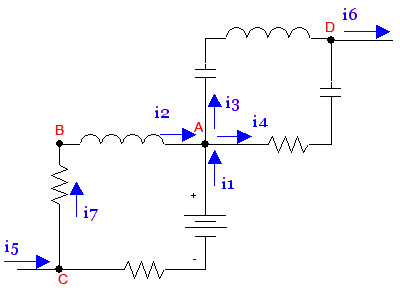
Image

Statement

Kirchhoff’s Current Law states that the algebraic sum of currents at a node (junction) is zero.

In simple terms:

Total current entering a junction = Total current leaving the junction

Mathematical Expression

I=0

Physical Meaning

KCL is based on the conservation of electric charge. A node cannot store charge; therefore, whatever current flows into it must flow out.

Example

If:

  • Current entering a node = 5 A

  • One branch carries 2 A away

  • Another branch carries 1 A away

Then remaining current:

I=5(2+1)=2 A


Kirchhoff’s Voltage Law (KVL)

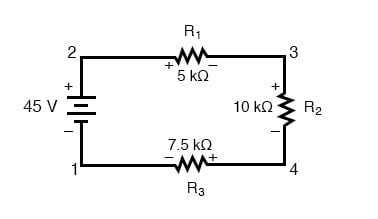
Image

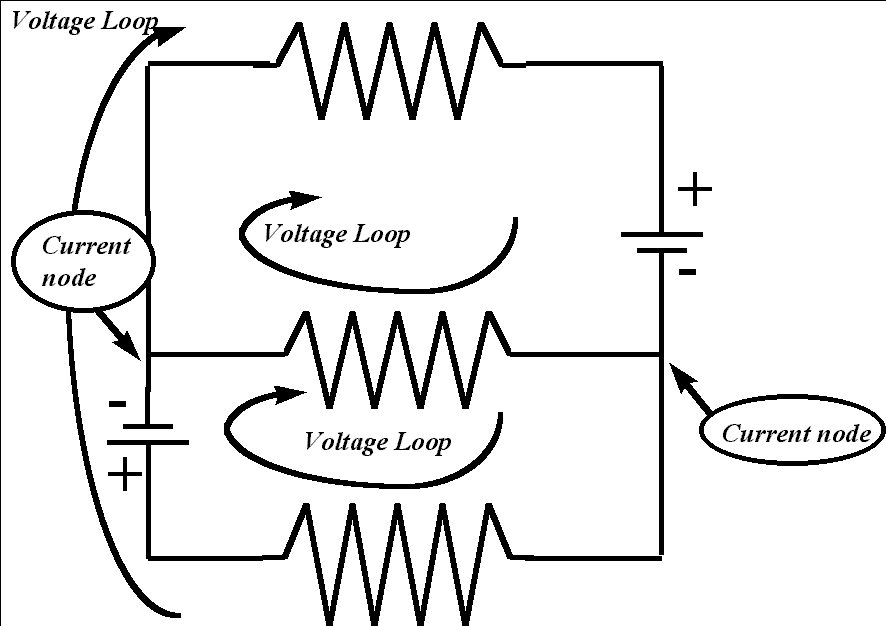
Image

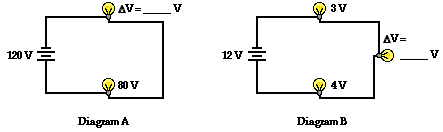
Image

Statement

Kirchhoff’s Voltage Law states that the algebraic sum of all voltages around any closed loop in a circuit is zero.

Mathematical Expression

V=0

Physical Meaning

KVL is derived from the conservation of energy. Energy supplied by voltage sources equals the energy consumed by circuit elements such as resistors.

Example

Consider a loop with:

  • Battery voltage = 12 V

  • Voltage drop across R₁ = 5 V

  • Voltage drop across R₂ = 7 V

1257=0


Step-by-Step Problem Using KVL

Image

Image

Given

  • Voltage source = 10 V

  • Resistors: R₁ = 2 Ω, R₂ = 3 Ω

Solution

Total resistance:

R=2+3=5 Ω

Circuit current:

I=V/R=10/5=2 A

Voltage drops:

  • V1=2×2=4

  • V2=2×3=6

Check using KVL:

1046=0

✔ KVL is verified.


Importance of Kirchhoff’s Laws

Kirchhoff’s Laws are crucial because they:


Applications of Kirchhoff’s Laws


Key Differences Between KCL and KVL

Feature          KCLKVL
Based on             Conservation of charge         Conservation of energy
Applied at NodeLoop
Used inNodal analysisMesh analysis


Conclusion

Kirchhoff’s Laws are fundamental tools that enable engineers to analyze and design reliable electrical circuits. By mastering KCL and KVL, one can systematically solve even the most complex electrical networks with confidence and accuracy.


Resistivity: The "DNA" of Electrical Flow

We all know what Resistance is—it’s the "friction" that slows down an electric current. But if Resistance is the behavior of an ob...