Kirchhoff’s Laws Explained: KCL and KVL with Simple Examples and Diagrams
Introduction to Kirchhoff’s Laws
Kirchhoff’s Laws were formulated by the German physicist Gustav Kirchhoff and form the backbone of electrical circuit analysis. These laws are essential for analyzing complex electrical networks where simple Ohm’s Law alone is insufficient. Every electrical engineering student, technician, or practitioner must master these laws to solve real-world circuit problems accurately.
Kirchhoff introduced two fundamental principles:
Kirchhoff’s Current Law (KCL)
Kirchhoff’s Voltage Law (KVL)
Together, these laws are universally applicable to DC and AC circuits, making them indispensable in power systems, electronics, and control engineering.
Kirchhoff’s Current Law (KCL)
Statement
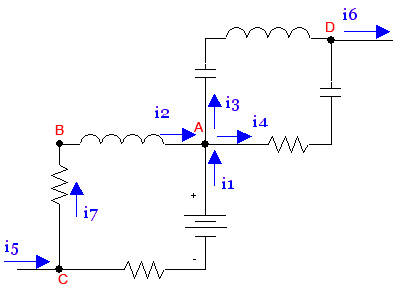
Kirchhoff’s Current Law states that the algebraic sum of currents at a node (junction) is zero.
In simple terms:
Total current entering a junction = Total current leaving the junction
Mathematical Expression
∑I=0
Physical Meaning
KCL is based on the conservation of electric charge. A node cannot store charge; therefore, whatever current flows into it must flow out.
Example
If:
Current entering a node = 5 A
One branch carries 2 A away
Another branch carries 1 A away
Then remaining current:
Kirchhoff’s Voltage Law (KVL)

Statement
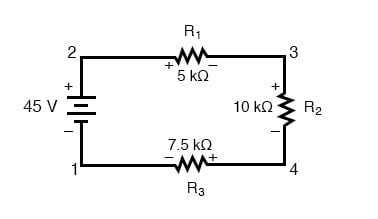
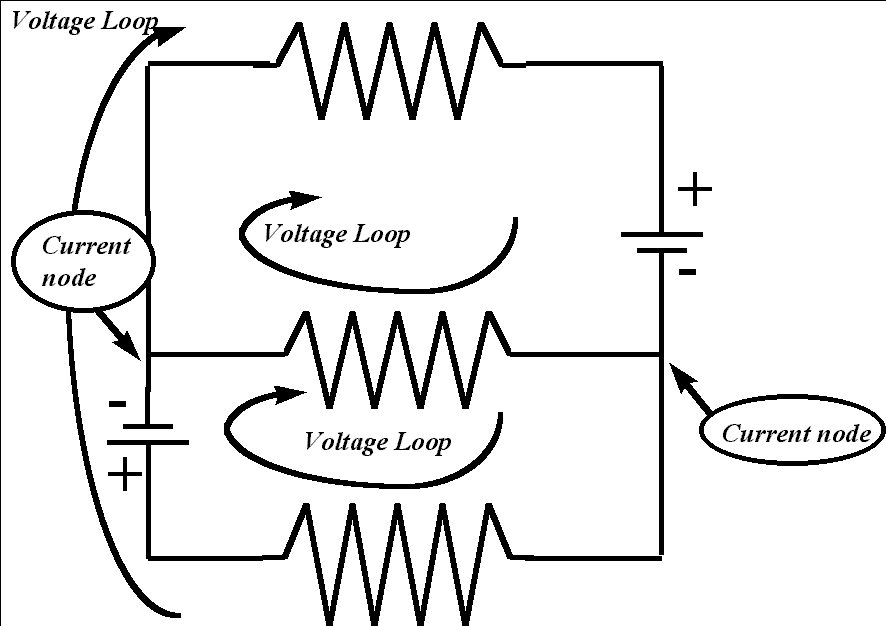
Kirchhoff’s Voltage Law states that the algebraic sum of all voltages around any closed loop in a circuit is zero.
Mathematical Expression
∑V=0
Physical Meaning
KVL is derived from the conservation of energy. Energy supplied by voltage sources equals the energy consumed by circuit elements such as resistors.
Example
Consider a loop with:
Battery voltage = 12 V
Voltage drop across R₁ = 5 V
Voltage drop across R₂ = 7 V
12−5−7=0
Step-by-Step Problem Using KVL

Given
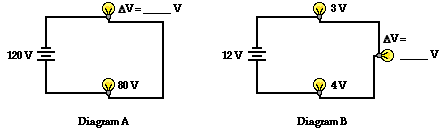
Voltage source = 10 V
Resistors: R₁ = 2 Ω, R₂ = 3 Ω
Solution
Total resistance:
Circuit current:
Voltage drops:
Check using KVL:
✔ KVL is verified.
Importance of Kirchhoff’s Laws
Kirchhoff’s Laws are crucial because they:
Allow analysis of complex multi-loop circuits
Are valid for DC and AC systems
From the foundation of mesh and nodal analysis
Are widely used in power systems, electronics, and network theory
Applications of Kirchhoff’s Laws
Battery and charging system analysis
Control systems and instrumentation
Network theorems (Thevenin, Norton, Superposition)
Key Differences Between KCL and KVL
|
|---|
Conclusion
Kirchhoff’s Laws are fundamental tools that enable engineers to analyze and design reliable electrical circuits. By mastering KCL and KVL, one can systematically solve even the most complex electrical networks with confidence and accuracy.


No comments:
Post a Comment